Our Mission
Design. Implement. Transform.
The National Clinical Sustainability Challenge is an interdisciplinary initiative inviting student teams to design and implement practical solutions for real-world healthcare sustainability problems. By integrating scientific, policy, and community perspectives, participants will create feasible interventions that make significant inroads toward reducing their health system’s environmental footprint while advancing quality improvement and their institution’s organizational mission.
This program goes beyond theory. It fosters leadership by creating an enduring educational framework for the next generation of climate-smart health leaders, equipping them with technical decarbonization skills and vital experience navigating institutional structures and overcoming barriers to change.
How It Works
- Identify the Problem: Student teams will pinpoint a sustainability issue within their own medical system, such as reducing operating room waste, improving pharmaceutical disposal, or optimizing food service.
- Target the Impact: Projects must specifically target one of the seven High-Impact Actions outlined in the Global Road Map for Health Care Decarbonization.
- Execute and Report: Over the 6-month challenge, teams will submit monthly progress reports for review by the MS4SF Climate Smart Health Care Board and dedicated faculty members from the Medical Society Consortium on Climate and Health.
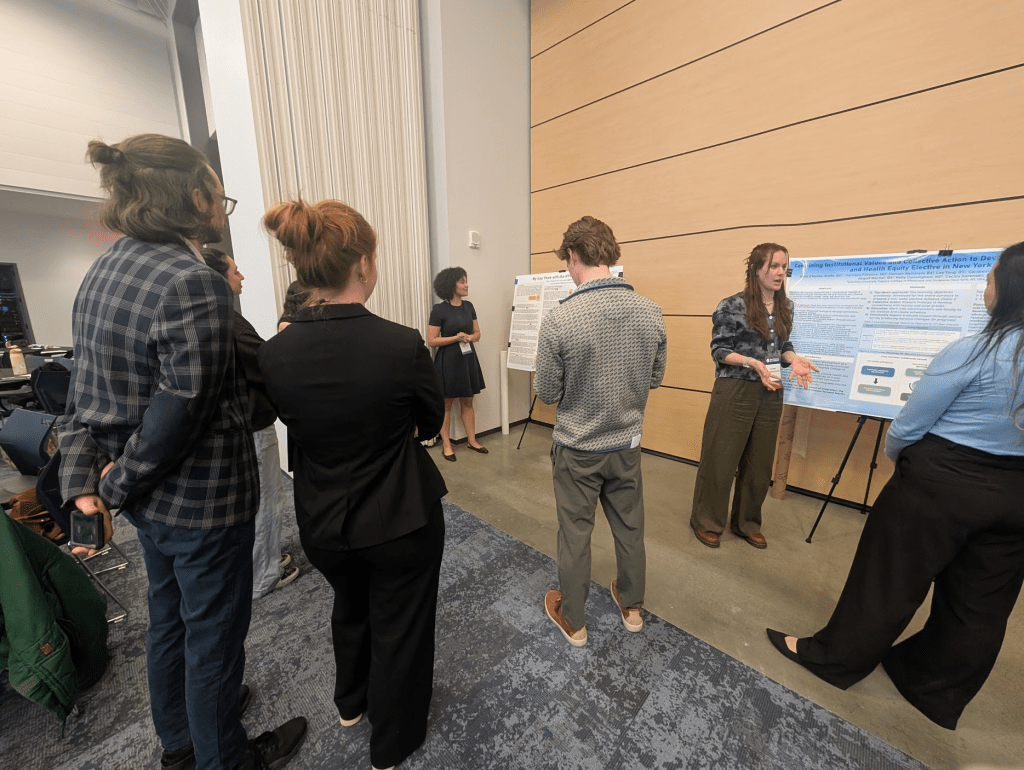
- Present and Compete: The challenge culminates after 6 months, when teams will compile a final report and present a poster to a board of evaluators at the MS4SF national conference.
Conference Support
Transforming your home health system requires resources, and we are committed to helping you showcase your work. We provide conference support to assist students with registration or travel costs to present their findings on a national stage.
Team and Mentor Requirements
- Team Size: Minimum 2 students, maximum 5 students.
- Team Composition: There must be at least one medical student on the team. The team should appoint one person to be the primary point of contact for all communication with the MS4SF Climate Smart Health Care Board.
- Interdisciplinary Focus: Additional team members can be from any health professions program (nursing, pharmacy, nutrition, PT, OT, etc.), and priority will be given to interdisciplinary teams.
- Faculty Mentorship: Every team must identify a faculty advisor at their home institution with experience in healthcare sustainability. These faculty mentors will help prepare and review all deliverables and provide active guidance to the team.
Challenge Timeline and Deliverables
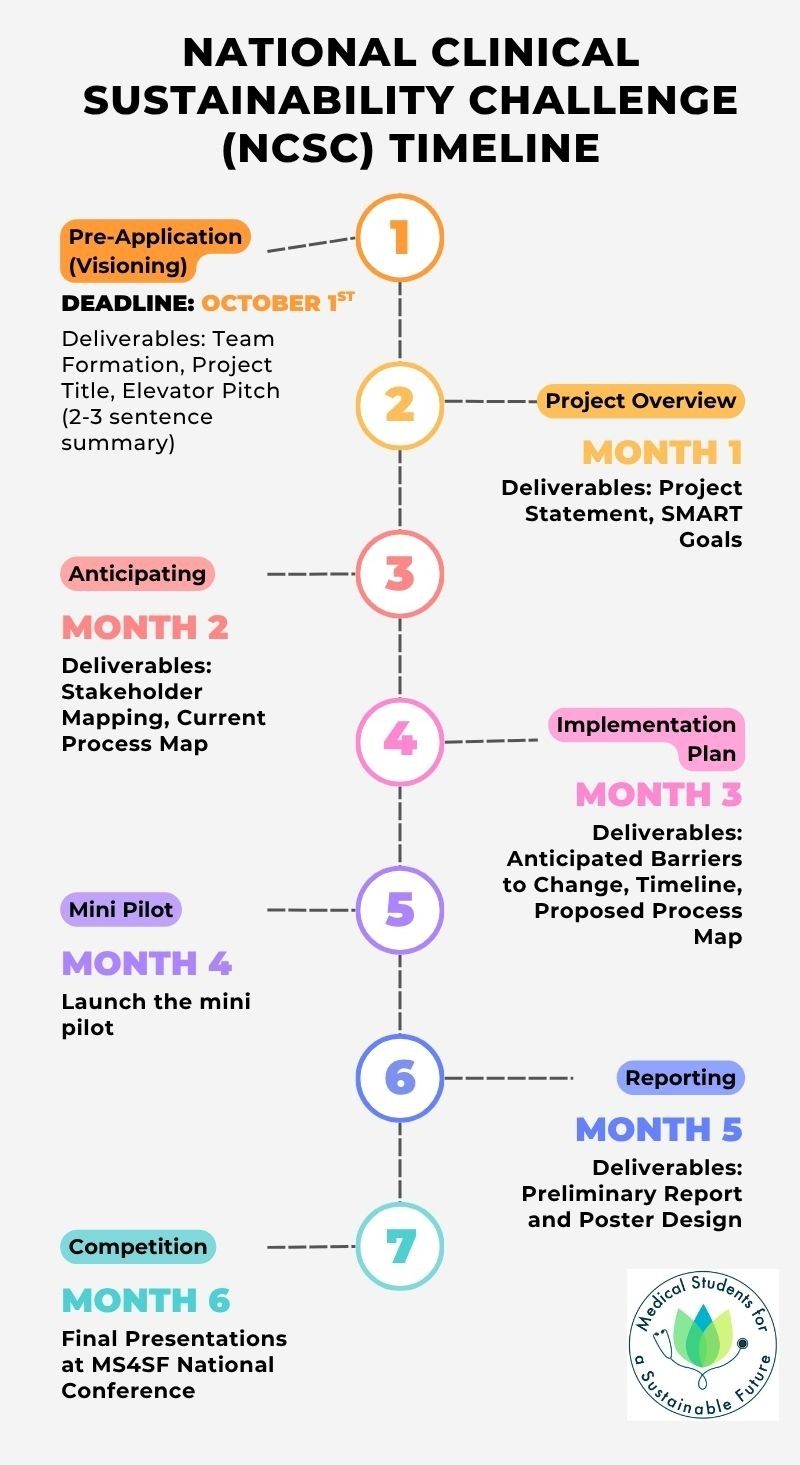
The NCSC is structured to turn a vision into a viable pilot over 6 months.
| Phase | Focus | Monthly Deliverable |
| Pre-Application | Visioning | Team Formation, Project Title, and a 2-3 sentence Elevator Pitch |
| Month 1 Deadline: November 16th, 2026 | Project Overview | Problem Statement and SMART Goals |
| Month 2 Deadline: December 14th, 2026 | Anticipating | Stakeholder Mapping and Current Process Map |
| Month 3 Deadline: January 19th, 2027 | Implementation Plan | Anticipated Barriers to Change, Timeline, and Proposed Process Map |
| Month 4 | Action | Mini Pilot launch |
| Month 5 Deadline: March 26th, 2027 | Reporting | Preliminary Report and Poster Design |
| Month 6 April 2027 | Competition | Final Presentations at MS4SF National Conference |
Resources and Application
Ready to transform healthcare?
Please use the Application Form to submit your application.
Start by gathering your team and developing your Deliverable 1 (Visioning & Elevator Pitch), which will serve as your official application. The deadline to apply is October 1st, 2026.
Example Project: Review our sample project, “Breathe Easy, Dispose Safely,” an ambulatory care inhaler recovery program designed to reduce hydrofluoroalkane (HFA) greenhouse gas emissions and recycle aluminum canisters.
FAQs
Team Formation & Eligibility
- Who can participate in the challenge? Teams must consist of at least two students and no more than five. While other team members can be from any program (nursing, pharmacy, etc.), a medical student must be on the team.
- Do we have to be an interdisciplinary team? There is no hard requirement for an interdisciplinary team, but priority will be given to those that include students from different healthcare disciplines.
- Who should be our faculty advisor? Ideally, your advisor should be a faculty member with experience in healthcare sustainability who can guide and monitor your progress. While they do not have to be a physician, they should be someone with the expertise and bandwidth to help you navigate institutional barriers.
- Can we have an advisor from outside our institution? We generally recommend an advisor from your own institution to help navigate local systemic issues, but if you are struggling to find a mentor, please email the executive team for guidance.
Project Scope and Requirements
- What kind of projects are eligible? Projects should identify a sustainability problem within your own medical system and propose a feasible intervention that can address the problem within 6 months. The intervention must align with one of the seven High-Impact Actions outlined in the Global Road Map for Health Care Decarbonization.
- Does this need to be a formal research project? No. This challenge is focused on Quality Improvement (QI) initiatives and practical implementation rather than traditional academic research.
- What are the “7 High-Impact Actions”? These are strategic areas designed to mitigate healthcare emissions effectively. You can find the full list and descriptions in the Global Road Map Executive Summary.
The Process
- What is the time commitment? The program is a 6-month challenge. Each month, your team will be required to submit a progress report or specific deliverable to the MS4SF Climate Smart Health Care board for review and feedback.
- What should we do before submitting Deliverable 1? Before your first submission, we strongly suggest you brainstorm your vision, talk with your local healthcare leadership, and ensure you have the necessary permissions to propose changes within your system.
- How are the monthly deliverables reviewed? The MS4SF Climate Smart Health Care team along with some dedicated faculty reviewers will evaluate your progress each month and provide feedback via email and/or synchronous Zoom meetings to help refine your project.
Support and Education
- What if our team is not knowledgeable about sustainable QI, but would still like to participate? What educational support will our team receive during the challenge? To help build interdisciplinary capacity in sustainable healthcare quality improvement, teams will receive foundational training delivered by Medical Society Consortium on Climate and Health faculty during the first month of the program. This training consists of a series of lectures covering healthcare emissions sources, systems-based QI methodology, stakeholder engagement, process mapping, and approaches to measuring environmental impact. The lectures and other resources will be available on the MS4SF website for students to review throughout the program.
- What is the sustainable QI resource repository, and who can access it? All educational materials, recorded lectures, and foundational training materials from the program are archived into a reusable resource repository. This repository includes dedicated lessons on sustainability in healthcare alongside fundamental QI basics. The repository is designed to be an open access, freely accessible resource bank.
Conference Presentations
- How are the top teams decided? Student teams will present their reports and posters at the MS4SF national conference to a board of evaluators. The top three teams are chosen based on the feasibility and impact of their implementation.
- Does the challenge cover travel costs? Yes, conference support is available to help student finalists with registration or travel costs for presenting their findings.

